Electrical, Rigging & Internet Orders at Vegas Venues
The services that sink budgets aren't your booth — they're power, rigging, and internet ordered through the venue.
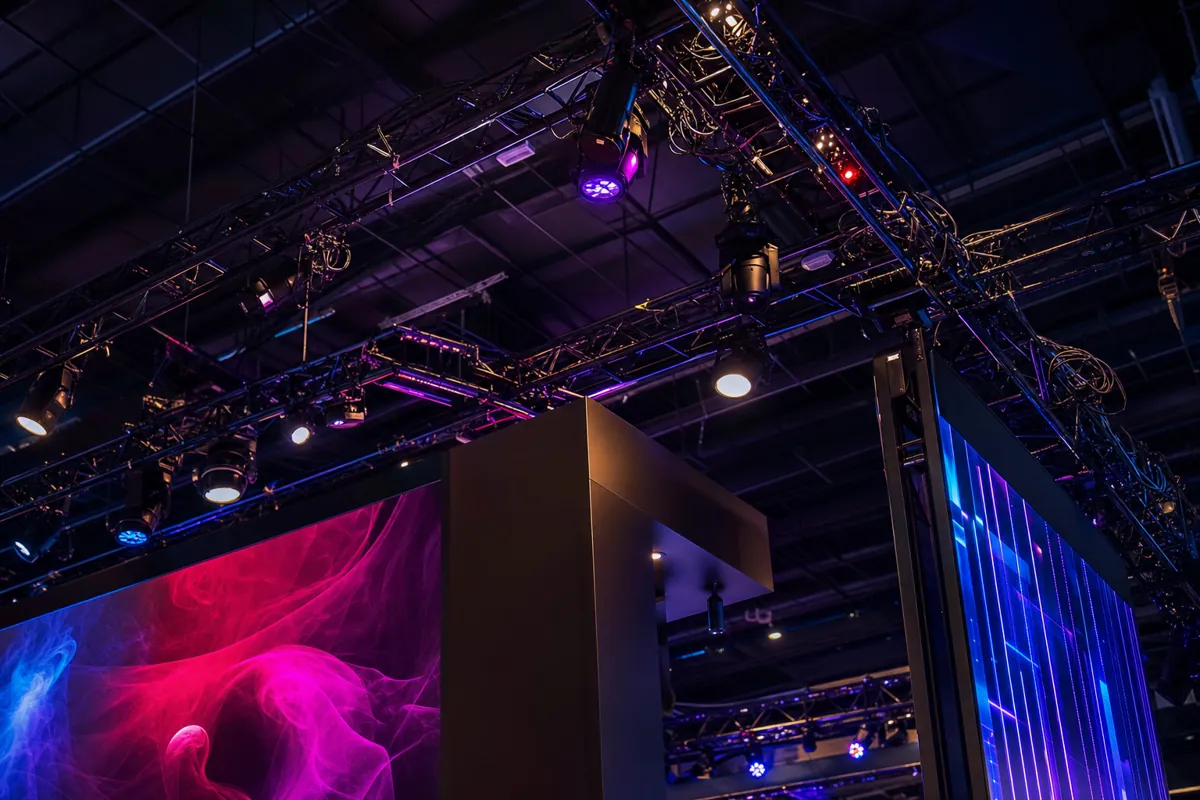
You budgeted carefully for your booth, your flights, and your shipping. Then the venue service orders landed — electrical, rigging, internet — and suddenly the math got ugly. This is the part of Las Vegas exhibiting that catches even experienced teams off guard, because these services don't come from your booth builder. They're ordered separately, through the venue or its official contractors, on their deadlines and at their rates.
Here's how the system actually works at venues like the Las Vegas Convention Center, what your LED wall really needs to run, why free hall Wi-Fi will embarrass you in front of a prospect, and how advance deadlines quietly decide whether you pay a fair price or a panic price.
- Power, rigging, and internet are ordered through the venue/contractor — not your booth builder — and aren't in your booth quote.
- Published advance prices for one 5-amp outlet: $115.35 (CES 2027 topline) to $170.75 (NAB Show 2026) at the LVCC, $273.10 at PACK EXPO International 2026, $168.86 at the OCCC in Orlando; the Venetian Expo and Mandalay Bay publish none.
- Calculate total amperage and mark exact drop locations before ordering power for LED walls and lighting.
- Skip the free hall Wi-Fi for anything that matters; order a dedicated hardwired line for demos.
- Advance deadlines mean real savings — submit electrical and rigging first since they have the earliest cutoffs.
- Always confirm current rates and deadlines in the specific show's exhibitor service manual.
Who you order from: venue vs show contractor vs your booth team
There are usually three separate vendors involved in getting your booth lit, hung, and connected — and confusing them is how things fall through the cracks.
- The venue / official electrical contractor handles electrical drops, rigging and hanging points, plumbing, and compressed air. At the LVCC and similar halls, these are exclusive services — you cannot bring your own electrician to wire your booth or your own rigger to hang a sign.
- The general show contractor (the company running that specific show's exhibitor services) handles things like carpet, furniture, material handling, and labor. They publish the exhibitor service manual where most order forms live.
- Your booth partner — that's us — builds and installs the physical booth, the LED video walls, SEG lightboxes, and graphics.
The key takeaway: your booth quote does not include power, rigging, or internet. Those are ordered through the show's manual, and they're often the line items exhibitors forget to budget.
What one outlet actually costs: the published 5-amp rates by venue
Every show prices power through its exhibitor kit, and most kits sit behind a login. These are the venues and shows that have put a 5-amp/500-watt 120V outlet price in public, read on the organiser’s, the venue’s or the official contractor’s own page and checked on September 4, 2026. They are the figures behind the electrical line in our landed-cost estimator.
| Venue (show) | Who provides power | One 5A/500W 120V outlet, advance | After the deadline |
|---|---|---|---|
| Las Vegas Convention Center (CES 2027 topline) | Freeman | $115.35 | $173.05 regular |
| Las Vegas Convention Center (NAB Show 2026) | Freeman | $170.75 plus 8.25% tax | standard rate after March 16, 2026 |
| The Venetian Expo | Event Service Electrical, the venue’s own exclusive provider | not published: ordered on the Venetian’s portal | early-bird and standard deadlines set per show |
| Mandalay Bay Convention Center | Edlen Electrical, exclusive since 1999 | not published: ordered at mandalaybayexhibitorservices.com | online orders earn up to a 30% discount |
| McCormick Place, Chicago (PACK EXPO International 2026) | PACK EXPO Services | $273.10 | advance rate needs payment and a floor plan by September 2, 2026 |
| Orange County Convention Center, Orlando (NADA Show, InfoComm) | The OCCC itself, exclusive | $168.86 incentive rate | $271.69 base, $387.22 on-site |
Where each figure was read, and what else the same page lists:
- CES 2027 at the LVCC: the CES exhibitor manuals page lists a 500-watt outlet at $115.35 advance and $173.05 regular, a 2000-watt/20-amp outlet at $243.10 advance and $364.60 regular, and electrical labour at $128.35 straight time and $245.60 overtime; final figures publish in the September manuals.
- NAB Show 2026 at the LVCC: NAB’s commonly ordered items sheet lists the 5-amp/500-watt outlet at $170.75 plus 8.25% tax ($184.83) and a 20-amp/2000-watt outlet at $448.50 before the March 16, 2026 deadline, materials and floor-work labour included.
- The Venetian Expo: the Venetian Exhibitor Success Guide publishes rules, not prices: outlets over 15 amps or above 120 volts need electrical labour with a one-hour minimum, and an order below the minimum carries a $50 labour-and-preparation charge.
- Mandalay Bay: Edlen’s Mandalay Bay office has been the exclusive temporary-power provider there since 1999; prices appear only inside its ordering site.
- PACK EXPO International 2026 at McCormick Place: PACK EXPO Services’ public ExpoPortal catalogue lists floor outlets at $273.10 for 500 watts, $390.90 for 1000 watts, $595.15 for 1500 watts, $644.40 for 2000 watts and $1,220.95 for 3000 watts, with cords and power strips bundled into the outlet price.
- Orange County Convention Center: the OCCC exhibitor services price list effective October 1, 2025 prices the 120V 5-amp floor outlet at $168.86 incentive, $271.69 base and $387.22 on-site, with initial labour, placement and 24-hour power included; NADA Show’s own page lists $173.07.
Three things the table shows. The spread at one venue is real: the same Las Vegas hall prices a 5-amp outlet anywhere from $115 to $171 depending on the show and the year, so the show’s kit governs, never a rule of thumb. The deadline is worth more than the shopping: CES’s regular rate is 50% above its advance rate, and the OCCC’s on-site rate is more than double its incentive rate. And the two Las Vegas venues that publish nothing, the Venetian Expo and Mandalay Bay, both run in-house or exclusive contractors whose prices appear only inside the ordering portal, so budget from the LVCC range and confirm the day your space is confirmed.
One outlet is rarely the bill. An LED wall or a lit tower needs its own circuit, 24-hour power for a media server that cannot reboot is priced separately and at some venues doubles the outlet rate, and anything over 20 amps or above 120 volts adds electrical labour at the contractor’s hourly rate.
Power planning: what your LED wall and lighting actually need
An LED video wall is not a poster — it's a powered display that draws real current, and it needs the right amperage delivered to the right spot on the floor. Under-ordering power is one of the most common and most disruptive day-one problems we see.
Two things matter: how much power and where it lands.
- Amperage: Tally the draw of every LED tile, processor, lighting fixture, monitor, charging station, and demo machine in your booth. LED walls and bright lighting add up fast. When in doubt, order the next size up — adding power on-site is expensive and slow.
- Drop placement: Power is delivered to a specific point. If your drop is in the wrong corner, you're running visible cords across your booth or paying labor to move it. Mark exact drop locations on your floor plan before you order.
- 24-hour vs show-hours power: If anything needs to stay on overnight — media servers, refrigeration, certain LED processors — you must order dedicated 24-hour power, which is priced differently.
- Labor to distribute: At many halls, the electrical contractor must run power under the carpet and make connections. Factor that labor in.
When you order an LED wall through us, we'll tell you the exact power requirements so your electrical order is right the first time. Send us your booth size and we'll spec it on your trade show booth plan.
Rigging and hanging signs: order early or don't order at all
If your design includes a hanging sign, an overhead banner, or any suspended structure, that's rigging — and it's tightly controlled. Rigging points are ordered through the venue's official contractor, and they involve both the hardware (motors, points, truss) and the labor (riggers who hang it).
Two things bite exhibitors here:
- Deadlines are firm. Rigging often has earlier cutoffs than other services because crews schedule overhead work before the floor fills up. Miss the deadline and your sign may not go up at all.
- Structural details matter. The contractor needs weights, dimensions, rigging plots, and sometimes engineering documentation. Get these from your booth builder early so the order is complete.
Hanging signs dramatically improve visibility on a busy show floor — but only if the rigging order is placed on time with accurate specs. We'll provide the documentation you need.
Why free hall Wi-Fi isn't enough for a live demo
Every major Las Vegas venue offers complimentary or low-cost shared Wi-Fi in the halls. It's fine for checking email. It is not fine for running a live demo, streaming content to an LED wall, processing payments, or anything a prospect is watching.
The reason is simple: tens of thousands of attendees and exhibitors share that same network. At peak hours it slows to a crawl or drops entirely — and it will do so at the exact moment you're mid-pitch.
If connectivity matters to your booth, order dedicated, hardwired internet through the venue:
- Hardwired line for anything mission-critical — demos, video playback, point-of-sale.
- Dedicated bandwidth sized to your needs; ask about guaranteed (not shared) speeds.
- A private network / VLAN if you're handling sensitive data or want your own SSID.
This is especially true at tech-heavy shows like AWS re:Invent and broadcast-focused events like NAB Show, where attendees expect flawless live demos and the network demand on the floor is enormous. Treat dedicated internet as part of your demo plan, not an afterthought.
Advance deadlines: the difference between fair price and panic price
Venue and contractor services are priced in tiers. Order before the published advance deadline and you pay the base rate. Miss it and you jump to standard or on-site pricing — often a significant premium for the exact same service.
On-site rates aren't a small bump. They exist to discourage last-minute orders that strain the contractor's labor and scheduling, so the markup is real. The savings from ordering early can be substantial, but exact figures vary by show — always confirm current rates and deadlines in that show's exhibitor service manual.
A simple rhythm that keeps you on the early side:
- The moment your space is confirmed, locate the exhibitor service manual and write down every advance deadline (electrical, rigging, internet, material handling).
- Finalize your booth design and power needs early so you can order accurately, not guess and over-order.
- Submit electrical and rigging first — these have the earliest cutoffs and the most labor dependencies.
- Order dedicated internet at the same time; it sells out at the busiest shows.
A pre-order checklist before you submit anything
Run through this list with your booth plan in hand:
- Total amperage calculated from every powered item.
- Drop locations marked on a to-scale floor plan.
- 24-hour power identified for anything that can't reset overnight.
- Rigging specs — weights, dimensions, rigging plot — ready for the contractor.
- Internet — hardwired line and bandwidth sized to your demos.
- Deadlines for each service noted, with a buffer so you submit days early.
- Labor accounted for, since power distribution and rigging require contractor crews.
If you're not sure what your display draws or needs overhead, that's exactly the gap our custom design process fills. We hand you the specs so your service orders are right the first time.
Frequently asked
How much does a 5-amp electrical outlet cost at the Las Vegas Convention Center?
The published advance rates run from $115.35 for one 500-watt outlet on CES 2027's topline to $170.75 plus 8.25% tax on NAB Show 2026's commonly-ordered-items sheet, both through Freeman; the regular rate after the deadline is higher (CES lists $173.05). The Venetian Expo and Mandalay Bay do not publish outlet prices: they are ordered on the Venetian's portal and through Edlen Electrical respectively.
Can I use my own electrician or rigger at the LVCC?
No. At the Las Vegas Convention Center and most major venues, electrical and rigging are exclusive services provided through the venue's official contractor. You order them through the show's exhibitor manual, separate from your booth build.
How much power does an LED video wall need?
It depends on the wall's size, pixel pitch, brightness, and processing — there's no single number. The safe approach is to total the draw of every tile and component and order the right amperage with correctly placed drops. We provide exact power specs for any LED wall we supply.
Is the free convention center Wi-Fi good enough for a demo?
No. Free hall Wi-Fi is shared by thousands of users and becomes unreliable at peak hours. For live demos, streaming, or payments, order a dedicated hardwired internet line with guaranteed bandwidth through the venue.
What happens if I miss the advance order deadline?
You'll typically be bumped to standard or on-site pricing, which can be significantly higher for the same service — and some services like rigging may not be available at all after the cutoff. Confirm exact deadlines and rates in the show's exhibitor service manual.
Does my booth quote include power and internet?
No. Your booth quote covers the physical structure, displays, and graphics. Electrical, rigging, and internet are ordered separately through the venue and show contractor. We'll give you the specs you need to order them accurately.
Keep going
Planning a Las Vegas booth?
Tell us your show — a free quote, usually same day.