LED Video Wall vs. Printed Graphics for Your Booth
A practical guide to choosing—or combining—LED video walls, backlit lightboxes, and printed graphics for your next show.
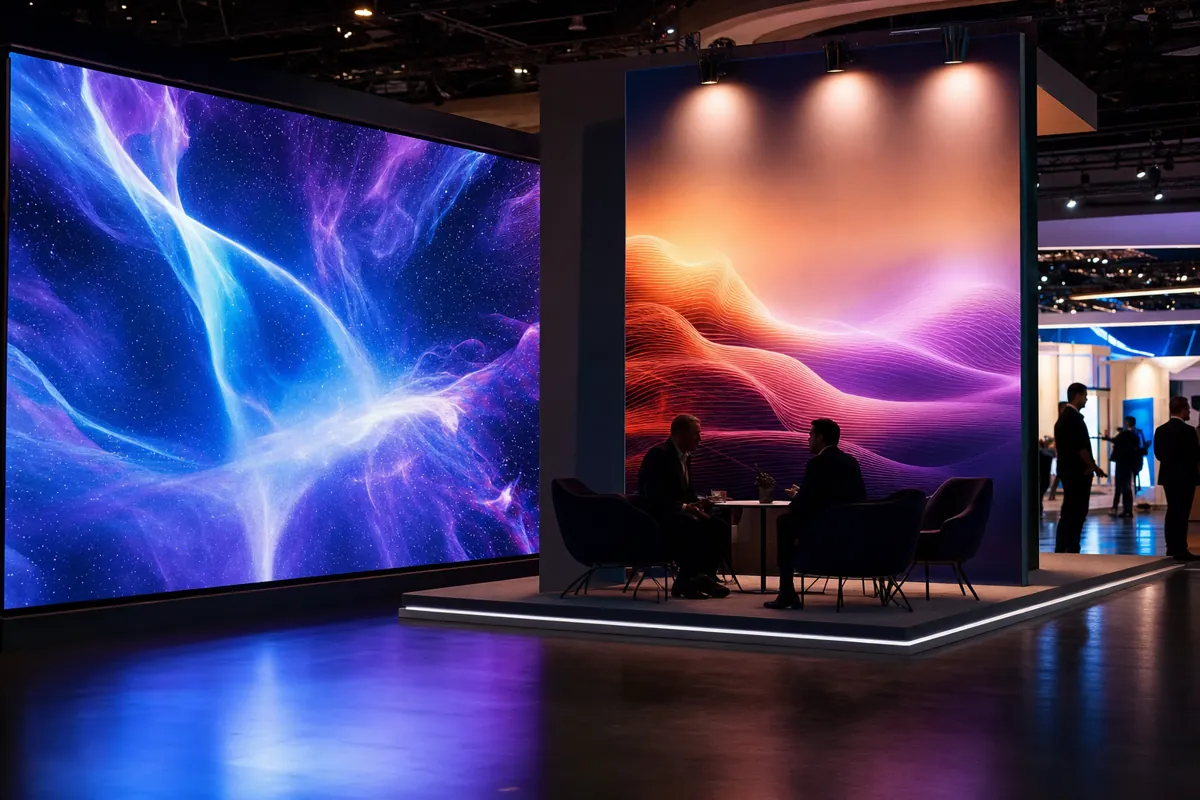
You've got a fixed budget, a finite floor plan, and one shot to stop traffic in a crowded hall. So which wins the back wall: a motion-packed LED video wall, or clean, reliable printed graphics? It's the most common design question we hear, and the honest answer is "it depends on what the wall has to do."
This guide breaks down the real trade-offs—visual impact, flexibility, cost, and brightness—so you can pick confidently, or combine the two for the best of both. No hype, just the stuff that actually changes how your booth performs on the floor.
- Choose LED when your message needs motion or frequent updates; choose print when your story is stable and budget is tight.
- SEG lightboxes are the underrated middle ground—vivid, swappable, lighter, and cheaper than LED.
- Match LED pixel pitch to viewing distance: 1.5–2.6mm for close-up walls, wider for distance.
- The best booths combine an LED focal point with lightbox storytelling.
- Never trust ballpark pricing—confirm power, rigging, and labor in the exhibitor manual and get a real quote.
The core difference: motion and reuse vs. fixed and cheap
A LED video wall is a screen built from modular panels. It plays video, loops animation, runs live demos, and lets you swap content in seconds—different message for the morning keynote crowd than the afternoon walk-ins, or an entirely new campaign at your next show.
Printed graphics—including fabric SEG lightboxes and rigid panels—are fixed. What you print is what shows for the run of the event. They're dramatically cheaper, dead-simple to install, and they never crash, buffer, or need a content file. The trade-off is that updating them means reprinting.
So the first question isn't "which looks better." It's: does your message need to move or change? If yes, LED earns its keep. If your core story is stable, print does the job for a fraction of the cost.
Visual impact on a busy show floor
Motion wins attention—that's not opinion, it's how peripheral vision works. In a wide hall like the ones at AWS re:Invent or NAB Show, a bright, moving LED wall pulls eyes from aisles away. It's why the biggest booths anchor their space with a video focal point.
But print isn't the weak sibling. A well-lit SEG lightbox delivers saturated, edge-to-edge color with zero distractions and reads beautifully in photos. For brand logos, key product shots, and a clean value proposition, a backlit graphic often communicates faster than a video that visitors have to stop and watch.
The practical takeaway: use LED for the thing you want people to see in motion, and print for the thing you want them to read and remember.
Pixel pitch and brightness: the specs that actually matter
Two LED terms decide whether your wall looks premium or pixelated:
- Pixel pitch is the distance between LEDs, in millimeters. Smaller number = finer, crisper image. A fine pitch like 1.5–2.6mm reads sharp when visitors stand a few feet away—ideal for in-booth walls people view up close. Wider pitches (3mm+) are fine for content seen from a distance but get chunky nearby.
- Brightness matters because trade show halls are bright. A wall that looks stunning in a dim showroom can wash out under hall lighting. Indoor LED walls are typically engineered to stay vivid under those conditions—confirm the nit rating with your provider for your specific space.
Rule of thumb: the closer your audience gets to the wall, the finer the pitch you want. A wall behind a presentation stage can run a wider pitch than one your visitors will press their nose against during a demo.
The middle ground: backlit SEG lightboxes
Before you assume it's LED-or-nothing, look at the option that splits the difference. SEG lightboxes are aluminum frames with edge or backlit LED illumination and a tensioned printed fabric face. They give you glowing, billboard-grade color—far more punch than a flat printed panel—without the cost, weight, or content management of a video wall.
Why exhibitors love them:
- Vivid and bright enough to compete in a busy hall.
- Swappable graphics: keep the frame, reprint the fabric for each show—much cheaper than new hardware.
- Lighter and simpler to ship, store, and install than LED.
For many booths at shows like ISC West, a row of lightboxes telling a clear product story is the smartest money on the wall. Don't overlook them just because LED is flashier.
Cost: what you're really paying for
We won't quote exact dollars—pricing swings with size, pitch, rental vs. purchase, and your specific show—so always confirm against the official exhibitor manual and get a real quote. But the relative order holds:
- Printed rigid/fabric panels — lowest cost; one-time print.
- SEG lightboxes — mid-range; reusable frame, reprintable graphic.
- LED video walls — highest; offset by reuse across multiple shows and the ability to update content with zero reprint cost.
Here's the angle that changes the math: if you exhibit several times a year, an LED wall (or a rental that travels with you) spreads its cost across every show, and you never pay to reprint a message that's already outdated. A wall of print, by contrast, may need replacing the moment your product or tagline changes.
The smart play: combine them
The strongest booths rarely choose one. They use a LED video wall as the motion focal point—live demos, looping hero video, real-time social feeds—and surround it with lightbox storytelling that holds the static essentials: logo, key specs, proof points, and a clear call to action.
That layering does two jobs at once: the LED stops traffic from the aisle, and the lightboxes give visitors something to read and absorb while a rep talks. If floor space or budget is tight, a single LED poster—a freestanding, plug-and-play digital sign—can deliver motion at the booth edge without committing to a full wall.
Map your content first: list every message, mark which ones need to move or change, and assign motion content to LED and stable content to print. The right mix usually reveals itself.
Frequently asked
Is an LED wall worth it for a small booth?
Often not as a full wall, but a single LED poster can give you motion in a 10x10 or 10x20 without dominating the space or budget. If your message is stable, a backlit lightbox may deliver more impact per dollar.
What pixel pitch should I choose?
Match it to viewing distance. For walls visitors stand close to, a fine pitch of about 1.5–2.6mm keeps the image crisp. Content seen only from across the aisle can use a wider pitch to save cost.
Will an LED wall wash out under hall lighting?
A properly spec'd indoor wall is built to stay vivid under bright hall conditions. Ask your provider for the brightness rating relative to your booth's lighting before you commit.
Can I reuse printed graphics at the next show?
Rigid prints are hard to reuse if your message changes. SEG lightboxes are designed for it—you keep the frame and just reprint the fabric face, which is far cheaper than new hardware.
How do I budget for any of these?
Costs vary widely by size, pixel pitch, rental versus purchase, and show. Always confirm electrical, rigging, and labor requirements in the official exhibitor manual, then request a quote for an accurate figure.
Keep going
Planning a Las Vegas booth?
Tell us your show — a free quote, usually same day.