Trade Show Drayage Fees in Las Vegas, Explained
The single biggest surprise on your show invoice, decoded — and how to shrink it.
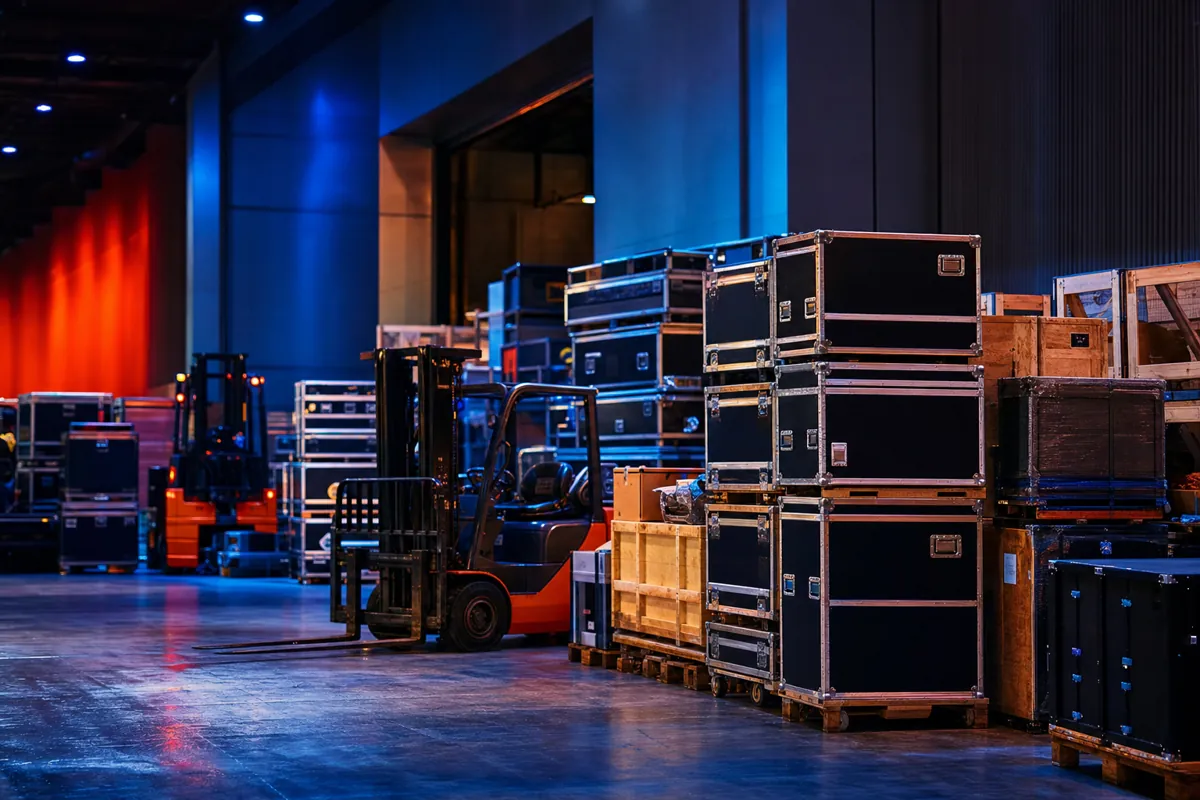
You budgeted for booth space, travel, and maybe a flashy display. Then the invoice from the official show contractor lands and there's a line item — "material handling" — that's hundreds or even thousands of dollars more than you expected. Welcome to drayage, the most misunderstood and most underestimated cost at any Las Vegas trade show.
The good news: drayage is predictable once you understand how it's billed, and it's controllable once you know what drives it. Here's everything an exhibitor needs to know before shipping a single crate to Las Vegas.
- Drayage is billed per 100 lbs, round trip, with a minimum per shipment that is usually 200 lbs.
- Three 150 lb boxes bill as 600 lbs, not 450. Consolidating to one pallet cuts that 25% for identical freight.
- Ballpark Las Vegas drayage is about $0.70-$1.85 per lb, but there is no single rate - it is set per show, per year, by that show's official contractor.
- Your binding number is in the exhibitor service manual under Material Handling, published before the shipping deadline.
- Crate weight is a recurring cost at every future show, so it belongs in the booth design conversation.
What drayage actually is (and what it isn't)
Drayage — officially called material handling — is the service of moving your freight from the loading dock to your booth space, storing your empty containers during the show, and moving everything back out at the end. It is billed by the official show contractor (usually GES or Freeman), not by the convention center itself and not by your freight carrier.
This trips up first-timers constantly. You pay one company to ship your crate to Las Vegas. You pay a separate company — the show contractor — to move that same crate the last few hundred feet from the dock into your booth. Drayage is that last leg, plus empty storage and the return trip.
It is not the cost of trucking your freight across the country, and it is not your booth space rental. It's a closed, contractor-controlled logistics service that nearly every U.S. show requires you to use.
Why drayage exists in the first place
Large venues like the Las Vegas Convention Center and Mandalay Bay can't have hundreds of exhibitor trucks and personal vehicles backing up to docks at random. The official contractor coordinates a single, scheduled flow of freight — forklifts, dock assignments, marshaling yards, and union labor — so the show can actually open on time.
That coordination is what you're paying for. It's also why you generally can't opt out: even if you carry your own materials in by hand, many shows have rules about what you can move yourself versus what must go through the contractor. Always check the exhibitor manual for the specific show's "privately owned vehicle" (POV) or cartload rules.
How drayage is calculated: CWT, minimums, and round trip
Drayage is billed per hundredweight (CWT) — per 100 lbs — with a minimum per shipment that is almost always 200 lbs, and the published rate covers the round trip: dock to booth, and booth back out again.
The arithmetic is simple, and it is where the money hides:
Say your show's advance-warehouse rate is R dollars per CWT (look it up — see below). You ship three boxes of 150 lbs each.
You are not billed for 450 lbs. Each shipment carries its own 200 lb minimum, so you are billed 3 × 200 = 600 lbs = 6 CWT, or 6R.
Consolidate those same three boxes onto one pallet at 450 lbs and you are billed 4.5 CWT, or 4.5R — 25% less for identical freight, purely for arriving as one shipment.
That is the single most common avoidable charge on a Las Vegas invoice, and it is decided before anything leaves your building.
The four things that move your number
- Weight, not volume. A heavy custom build costs more to move than a modular rental of the same footprint at every show you ever do. Crate weight is a recurring cost, so it belongs in the design conversation, not just the shipping one.
- Advance warehouse vs. direct to show site. Two separate rates. Advance is usually cheaper and far safer — your freight is already in Las Vegas and waiting. Direct-to- site can carry a surcharge and a narrow delivery window you do not control.
- Number of shipments. Each one carries its own minimum, per the example above.
- Special handling. Uncrated, loose, blanket-wrapped or side-door deliveries carry a surcharge, commonly on the order of a quarter to a third on top of the base rate.
What it costs — and how to get your exact number
As an order of magnitude, Las Vegas advance-warehouse drayage commonly lands around $0.70–$1.85 per lb (roughly $70–$185 per CWT), and show-site rates run higher. Use that to sanity-check a budget, never to place an order — because here is the part most pages will not tell you: drayage is priced per show, by that show's official general contractor, and it is re-set every year. Freeman, GES and the rest publish different numbers for different shows in the same hall in the same month. Any page quoting you a single Las Vegas CWT rate is quoting you somebody else's show. The two published anchors at the LVCC: CES 2027 lists $0.71 per lb for advance and direct freight with a 100 lb minimum, and NAB 2026’s commonly-ordered-items sheet listed $1.84 per lb before its deadline — the same hall, two and a half times the rate, set by the show.
Your binding rate is in the exhibitor service manual (the exhibitor kit) for your specific show, under Material Handling. It is published before the shipping deadline, so you can price it exactly rather than estimate it. Look for four figures:
- the advance-warehouse rate per CWT
- the show-site (direct) rate per CWT
- the minimum billed weight per shipment
- the special-handling surcharge, and what triggers it
Put those into the calculation above and you have your real drayage cost, not a range.
What we can tell you precisely is our side of it, because we set those prices ourselves. Our setup and teardown is $500 per LED poster, $600 for a tri-fold, and $1,800 for a three-sided LED tower — and everything we send ships in rolling flight cases, which is a deliberate choice: cased equipment ships as one consolidated, crated shipment rather than as loose special-handling freight.
Concrete ways to lower your drayage
You can't avoid drayage, but you can shrink it dramatically. The lever that matters most is weight.
- Ship lighter. Every 100 lbs you don't ship is money saved at the CWT rate. Audit your crate list and cut anything you can source locally.
- Rent your big, heavy elements locally instead of shipping them. LED video walls, large custom structures, and lightboxes are heavy and bulky — exactly what drives drayage up. Renting them in Las Vegas means they never cross a scale on your invoice. See our buy or rent breakdown to weigh the math for your situation.
- Consolidate shipments. Because of per-shipment minimums, three small boxes can cost more than one combined crate. Bundle freight into fewer, well-packed shipments.
- Crate properly. Loose, uncrated, or improperly palletized freight triggers special-handling surcharges. Clean, stackable crates get the standard rate.
- Hit straight-time windows. Schedule move-in and move-out during regular hours to avoid overtime surcharges. The exhibitor manual lists the target dates.
- Use lightweight display formats. SEG fabric lightboxes and LED posters deliver big visual impact at a fraction of the shipping weight of hardwall builds. Lighter trade show booths and tension-fabric systems pay you back every time you exhibit.
How a local Las Vegas partner changes the equation
Here's the strategic shift: if your heaviest, most expensive-to-ship components — the video wall, the custom booth structure, the backlit displays — are built and delivered locally in Las Vegas, they never enter the drayage calculation at all. You ship only the light, essential items (or sometimes nothing at all), and your material handling bill collapses.
At Vivid Displays we rent and sell LED video walls, custom booths, SEG lightboxes, and LED posters with turnkey install for every major Las Vegas show — which means your big-ticket visuals show up on the floor without ever touching a freight scale or a shipping invoice. We also include custom booth design so you can plan the right footprint before you commit to anything.
Frequently asked
How is drayage calculated?
Per hundredweight - per 100 lbs - with a minimum billed weight per shipment that is almost always 200 lbs, and the published rate covers the round trip in and out. Three separate 150 lb boxes are billed as 600 lbs, not 450, because each carries its own minimum. Consolidating them onto one 450 lb pallet cuts that by 25%.
Why can't anyone tell me the drayage rate for Las Vegas?
You can get a ballpark - Las Vegas advance-warehouse drayage commonly runs about $0.70-$1.85 per lb, roughly $70-$185 per CWT - but not a figure you can order against. Drayage is priced per show by that show's official general contractor and re-set every year, so two shows in the same hall in the same month can differ. Your binding number is in your show's exhibitor service manual under Material Handling.
Is it cheaper to ship to the advance warehouse or direct to show site?
Usually the advance warehouse, and it is safer - your freight is already in Las Vegas and waiting rather than depending on a narrow delivery window you don't control. They are two separate published rates; compare both in your exhibitor kit.
What is special handling and how do I avoid it?
A surcharge - commonly a quarter to a third on top of the base rate - for freight that is uncrated, loose, blanket-wrapped, or needs side-door unloading. You avoid it by shipping crated and palletised. Everything we send ships in rolling flight cases partly for this reason.
What is the single biggest way to cut my drayage bill?
Consolidate into one shipment, then reduce crate weight. Minimums are charged per shipment, so arriving as one pallet instead of three boxes can cut the bill 25% for identical freight - and it costs nothing to do.
Does drayage cover getting my booth back out?
Yes. The published CWT rate is round trip - inbound to your space and outbound after the show. It is not a one-way charge you pay twice.
Keep going
Planning a Las Vegas booth?
Tell us your show — a free quote, usually same day.